What’s Happening in Louisville Could Solve a Housing Crisis
Share
Explore Our Galleries









Breaking News!
Today's news and culture by Black and other reporters in the Black and mainstream media.
Ways to Support ABHM?
By Tressie McMillan Cottom, The New York Times
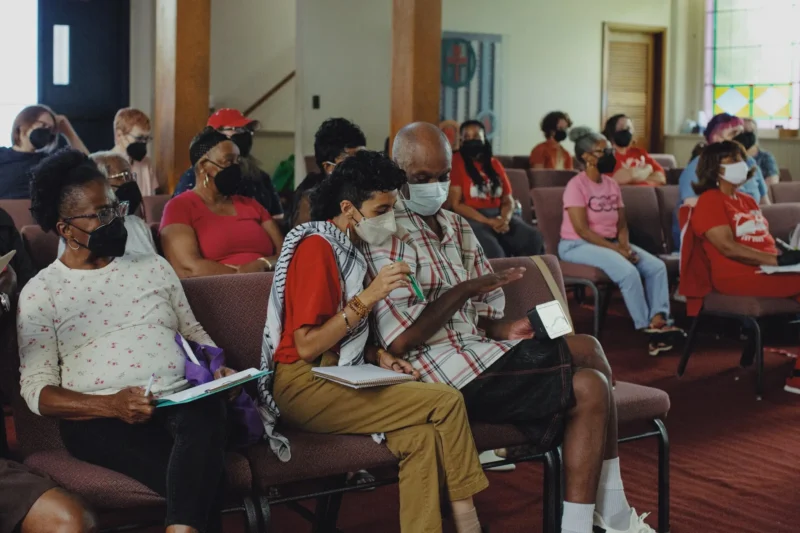
On an unseasonably warm day in late April in Louisville, Ky., the drone of low-flying helicopters overtook the usual sounds of spring as the wealthy descended on the Kentucky Derby. Less than five miles away in a historically Black neighborhood, Donna Goldsmith, 62, addressed a room of 15 people gathered around a scarred folding table. They are part of Louisville’s burgeoning tenants union, which mobilizes the residents of low-income apartment complexes, rural trailer parks and gentrifying neighborhoods to challenge the corporate landlords that they say have devastated affordable housing. This meeting, like most of their gatherings, started with testimonials.
Goldsmith initially organized her senior-living community to demand better maintenance, and now attends rallies across the city to encourage others to see themselves as leaders. Her most successful organizing strategy: “I cuss out landlords.” She had one message for this room of people mostly young enough to be her grandchildren. “I want to win before I die so that you all know that you can win,” she declared.
Midsize cities like Louisville contain many of the fault lines that created America’s housing crisis: gentrification, federal development schemes and redlining. But Louisville also has a distinctly Southern history of racist segregation, predatory investors and political divides that has made it difficult to produce the high-quality affordable housing its residents desperately need. If this country’s affordable housing crisis can be solved here, it could establish a template for helping the nation’s poor and marginalized find stability.
Josh Poe, 47, and Jessica Bellamy, 36, founded the Louisville Tenants Union in 2022 because they believe that organizing is the answer to the nation’s housing woes. “Tenant organizing,” Poe told me with pastoral conviction, “will be to the 21st century what labor organizing was to the 20th century.”
In a labor union, workers collectively bargain with management for better pay and benefits. A tenants union typically organizes renters to bargain with private and corporate landlords for ownership, fair rent and better living conditions. Renters have been organizing for decades, but the city’s divisions across race, class and geography mean that the Louisville Tenants Union has its work cut out for it.
Find more Breaking News here.
Explore our virtual exhibit galleries here.
Comments Are Welcome
Note: We moderate submissions in order to create a space for meaningful dialogue, a space where museum visitors – adults and youth –– can exchange informed, thoughtful, and relevant comments that add value to our exhibits.
Racial slurs, personal attacks, obscenity, profanity, and SHOUTING do not meet the above standard. Such comments are posted in the exhibit Hateful Speech. Commercial promotions, impersonations, and incoherent comments likewise fail to meet our goals, so will not be posted. Submissions longer than 120 words will be shortened.
See our full Comments Policy here.