Black hair restrictions in schools are a return to the Black Codes
Share
Explore Our Galleries









Breaking News!
Today's news and culture by Black and other reporters in the Black and mainstream media.
Ways to Support ABHM?
By David A. Love, TheGrio.com
…As kids throughout the country get out of school for the summer, it is a perfect time to reflect on all of the Black children who, over the course of the past semester, have been punished, disciplined or otherwise called out and singled out for wearing braids, locks, natural hair or any other culturally expressive hairstyle. Studying while Black, apparently, is a thing.
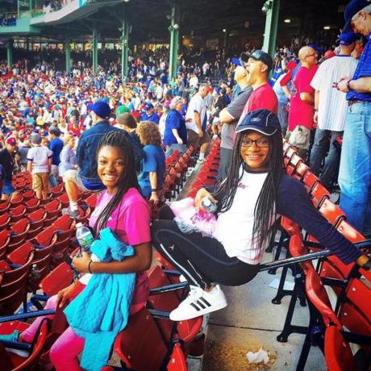
The Cook sisters at Fenway Park.
Consider some of the outrageous incidents that have taken place. In the Boston area, 15-year-old twin sisters faced detention and suspension for wearing braids, which their charter school claimed was a violation of the dress code. Mya and Deanna Cook, sophomores at Mystic Valley Regional Charter School in Malden, Mass., were banned from the prom and stripped of their extracurricular activities and sports team privileges for violating the school’s prohibition on wearing extensions.
…[In] 2009, a white Milwaukee teacher cut off the braid of Lamya Cannon, 7, because the girl was playing with her hair. After cutting off Lamya’s hair in front of the class, the teacher sent the girl back to her desk. Would this ever happen to a white girl with pigtails? And could we ever envision a Black teacher doing this to said white girl?…
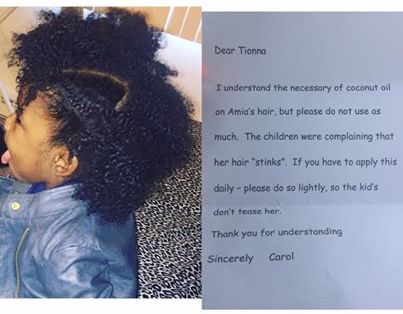
Tiona Norris, a self-described “unapologetically black mom” of a young schoolgirl, tweeted this note from her daughter’s teacher and commented, factually, that coconut oil has no stinky smell.
These days, when some in white America claim they are taking their country back, all the way up to the White House, it is no accident that Black children are punished for their Blackness. We know the studies about the disproportionate discipline against Black children, and black girls in particular. This is part of the school-to-prison pipeline, a regime of punishment following kids through adulthood. Most of all, it is an effort to monitor their bodies, not unlike the Black Codes established during Jim Crow to restrict the activities and labor of Black people and maintain white supremacy….
These codes, like the so-called dress codes in place at some schools today, serve the same purpose–to normalize whiteness and criminalize Blackness. When schools tell Black children the hair God gave them is an issue of bad hygiene and grooming, what they mean is they think Black people and their hair are less desirable. Some things never change. Institutional racism, not the hair, must change.
Read David A. Love’s article for TheGrio.com in its entirety here.
Read about how Black people are disproportionately punished in other institutions here.
Read about the Five Pillars of Jim Crow here.
Read about the education of Black children in the Jim Crow South here.
Read more Breaking News here.
Comments Are Welcome
Note: We moderate submissions in order to create a space for meaningful dialogue, a space where museum visitors – adults and youth –– can exchange informed, thoughtful, and relevant comments that add value to our exhibits.
Racial slurs, personal attacks, obscenity, profanity, and SHOUTING do not meet the above standard. Such comments are posted in the exhibit Hateful Speech. Commercial promotions, impersonations, and incoherent comments likewise fail to meet our goals, so will not be posted. Submissions longer than 120 words will be shortened.
See our full Comments Policy here.