Black South Carolina Trooper Explains Why He Helped a White Supremacist
Share
Explore Our Galleries









Breaking News!
Today's news and culture by Black and other reporters in the Black and mainstream media.
Ways to Support ABHM?
By Dan Barry, the New York Times
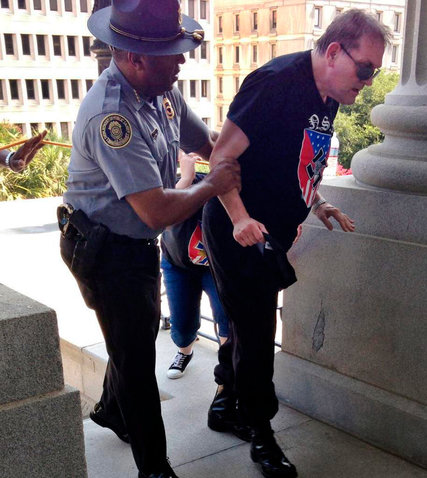
What the black state trooper saw was a civilian in distress. Yes, this was a white man, attending a white supremacist rally in front of the South Carolina State House. And yes, he was wearing a black T-shirt emblazoned with a swastika.
But the trooper concentrated only on this: an older civilian, spent on the granite steps. Overcome, it appeared, by an unforgiving July sun and the recent, permanent removal of a Confederate flag from state capitol display…
The meaning of this image — of a black officer helping a white supremacist, both in uniform — depends on the beholder. You might see a refreshing coda to the Confederate flag controversy; a typical day for a law-enforcement professional; a simplification of racial tensions that continue. But what does the trooper see?
His name is Leroy Smith, and he happens to be the director of the South Carolina Department of Public Safety. He was at the rally, working crowd control, because he likes to signal to his 1,300 subordinates that he has their backs.
Mr. Smith said he was taken aback by the worldwide attention but hoped the image would help society move past the recent spasms of hate and violence, including last month’s massacre of nine black people in a church in Charleston. Asked why he thinks the photo has had such resonance, he gave a simple answer: Love.
“I think that’s the greatest thing in the world — love,” said the burly, soft-spoken trooper, who is just shy of 50. “And that’s why so many people were moved by it.”…
At the State House on the day the photo was taken, Smith learned the Loyal White Knights of the Ku Klux Klan would be demonstrating. It promised to be a busy day…
Then a demonstrator directed his attention to an older man all but melting on a bottom step. “He looked fatigued, lethargic — weak,” Mr. Smith said. “I knew there was something very wrong with him.”
He called up the steps to the Columbia fire chief, Aubrey Jenkins, for assistance. Then, with his left arm around the man’s back and his right hand on the man’s right arm, he walked the swastika-adorned demonstrator up the steps, as many as 40. Slowly, steadily, all the while giving encouragement:
We’re going to make it. Just keep on going.
[…]
Up the steps the two men went. They didn’t talk much, although the older demonstrator allowed that he wasn’t from around here. A spokesman for the National Socialist Movement declined to identify him, other than to say he is a senior citizen who doesn’t need people knocking at his door…
As they approached the top step, someone nudged Rob Godfrey, 34, a deputy chief of staff to Governor Haley, who is known for his diligent chronicling of everyday history. He snapped a shot with his iPhone, sensing a distillation of the grace with which South Carolina has responded to these days of tragedy and strife.
“In that moment, Leroy Smith was the embodiment of all that,” Mr. Godfrey said. He quickly shared the moment with the world…
Mr. Smith did not know about the photograph. He knew only what was before him. He walked the man into the air-conditioned State House, led him to a green-upholstered couch, and left him there to cool down.
Read the full article here.
Read more Breaking News here.
Comments Are Welcome
Note: We moderate submissions in order to create a space for meaningful dialogue, a space where museum visitors – adults and youth –– can exchange informed, thoughtful, and relevant comments that add value to our exhibits.
Racial slurs, personal attacks, obscenity, profanity, and SHOUTING do not meet the above standard. Such comments are posted in the exhibit Hateful Speech. Commercial promotions, impersonations, and incoherent comments likewise fail to meet our goals, so will not be posted. Submissions longer than 120 words will be shortened.
See our full Comments Policy here.