GOP election tactics no surprise to Wisconsin’s Black voters
Share
Explore Our Galleries









Breaking News!
Today's news and culture by Black and other reporters in the Black and mainstream media.
Ways to Support ABHM?
by Harm Venhuizen, AP News
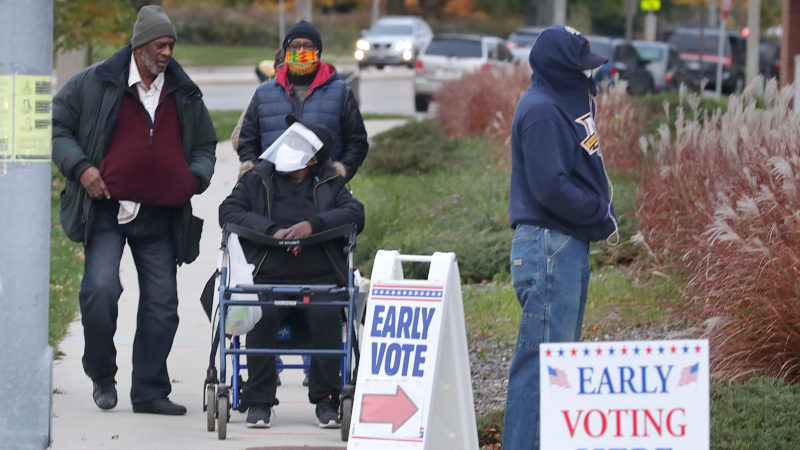
MILWAUKEE (AP) — Recent revelations about Republican election strategies targeting minority communities in Wisconsin’s biggest city came as no surprise to many Black voters.
A Wisconsin election commissioner bragged about low turnout in predominantly Black and Latino neighborhoods during last year’s elections. Weeks later, an audio recording surfaced that showed then-President Donald Trump’s Wisconsin campaign team laughing behind closed doors about efforts to reach Black voters in 2020.
Many people who voted this past week in the state’s primary election said they had long felt targeted by Republicans. The difference now is the public display of strategies that at best ignore the priorities of Black voters and at worst actively look to keep them from voting…
Voting rights advocates for years have accused Wisconsin Republicans of pushing policies to suppress voters of color and lower-income voters. Many such policies centered on the Democratic stronghold of Milwaukee, home to nearly 70% of Wisconsin’s Black population.
Those claims were reinforced by an email sent to about 1,700 people in December from Bob Spindell, a Republican member of the Wisconsin Election Commission. He said Republicans “can be especially proud” of depressed midterm voter turnout in predominantly Black and Latino neighborhoods in Milwaukee, a heavily Democratic city…
The Associated Press then obtained an audio recording of a meeting in which the head of Trump’s 2020 Wisconsin campaign team talked with staff about their efforts to reach Black voters: “We ever talk to Black people before? I don’t think so,” the campaign official said to laughter…
Republican-drawn legislative maps adopted last year dilute Milwaukee’s influence and nearly guarantee a Republican majority in the Legislature. That’s despite statewide races routinely being decided by narrow margins and Democrats winning the major statewide offices, including for governor, attorney general and secretary of state…
“Suppression is not just a few things.. It’s not just, not being able to vote without IDs. It’s not just, not being able to take your ballots to the drop box. It’s not just language barriers. It’s all those things together.”
Enjoy the complete article here.
For more Breaking News click here.
For more ABHM galleries click here.
Comments Are Welcome
Note: We moderate submissions in order to create a space for meaningful dialogue, a space where museum visitors – adults and youth –– can exchange informed, thoughtful, and relevant comments that add value to our exhibits.
Racial slurs, personal attacks, obscenity, profanity, and SHOUTING do not meet the above standard. Such comments are posted in the exhibit Hateful Speech. Commercial promotions, impersonations, and incoherent comments likewise fail to meet our goals, so will not be posted. Submissions longer than 120 words will be shortened.
See our full Comments Policy here.