How Black Americans View Success in the U.S.
Share
Explore Our Galleries









Breaking News!
Today's news and culture by Black and other reporters in the Black and mainstream media.
Ways to Support ABHM?
BY KHADIJAH EDWARDS, Pew Research Center
Most Black Americans consider themselves at least somewhat successful (66%). When asked to define what success means to them personally, 82% of Black adults point to the ability to provide for their family.
However, success isn’t exclusively related to financial achievements, a new Pew Research Center survey finds. Majorities of Black adults also cite quality-of-life measures such as personal happiness (80%), having enough time to do the things they want to do (65%) and having a job or career they enjoy (56%). A related analysis finds that most Black adults say they are at least somewhat happy and have enough time to do the things they want to do at least sometimes.
Roughly half of Black adults also say owning their own home (52%) and using their talents and resources to help others (50%) are essential to their personal definition of success.
Yet many of the measures Black adults use to define success are also major sources of pressure in their lives.
[…]
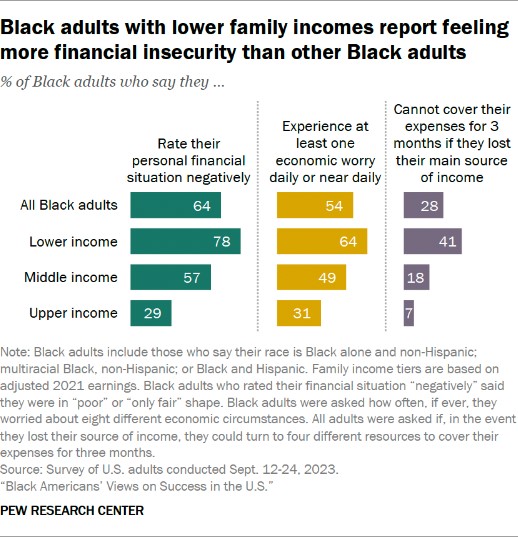
Although many Black adults experience similar levels of financial pressure, particular subgroups experience more financial insecurity than others. For example, Black adults with lower family incomes are more likely than those with middle or upper incomes to rate their personal financial situation negatively (78% vs. 57% and 29%, respectively).
Comments Are Welcome
Note: We moderate submissions in order to create a space for meaningful dialogue, a space where museum visitors – adults and youth –– can exchange informed, thoughtful, and relevant comments that add value to our exhibits.
Racial slurs, personal attacks, obscenity, profanity, and SHOUTING do not meet the above standard. Such comments are posted in the exhibit Hateful Speech. Commercial promotions, impersonations, and incoherent comments likewise fail to meet our goals, so will not be posted. Submissions longer than 120 words will be shortened.
See our full Comments Policy here.