I’m A Black Doctor. I Got Death Threats For Speaking About Racism — And It Gets Worse.
Share
Explore Our Galleries

Breaking News!
Today's news and culture by Black and other reporters in the Black and mainstream media.
Ways to Support ABHM?
By Amanda J. Calhoun, HuffPost
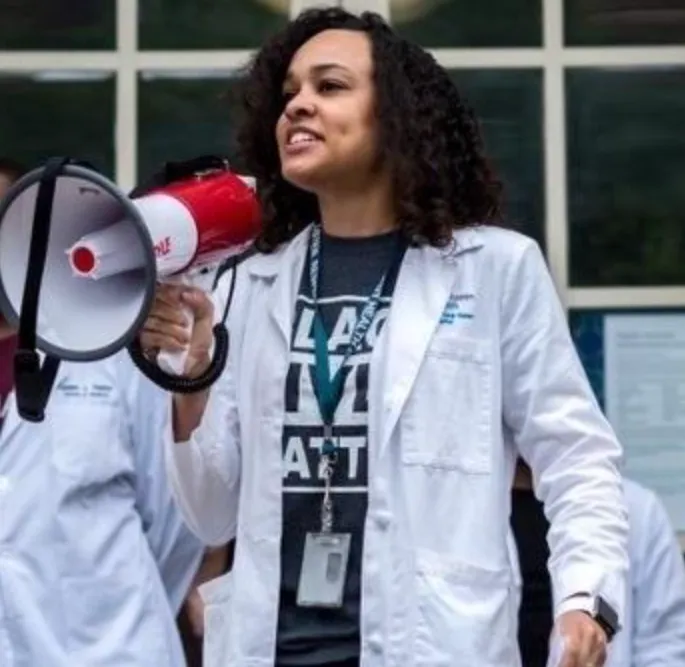
It’s now been a little more than a year since I received death threats while speaking out as a Black doctor. It happened when I was the keynote speaker for a White Coats for Black Lives demonstration at Yale School of Medicine. I implored my colleagues to understand that socioeconomic status does not protect Black lives from racism. Status does not protect my physician father from being followed by police in his neighborhood. Status did not protect my 8-year-old sister from experiencing a delay in medical care because white nurses did not believe my pharmacist mother when she said my sister was wheezing from anaphylactic shock. Status does not protect college-educated Black women, like me, from being more likely to die from pregnancy-related complications than white women who did not graduate from high school.
“Before I was a doctor, I was a Black woman in America, and my white coat will not protect me,” I declared.
After the speech was over, a friend told me I had received online death threats laced with racial slurs as my speech was streamed in real-time. The police were brought in, and investigations were made. I got calls from supervisors and advice about how to protect myself: Don’t walk alone. Let the police know if you receive a call from an unknown number. I was pulled off my call shift. My colleague gladly covered for me, and adamantly refused when I offered to pay him back.
But dealing with anonymous death threats isn’t the most difficult part of being a physician activist. They’re scary, but they are instantly recognized as unacceptable, something to be acted upon. I was supported without question and I had nothing to prove. Unfortunately, standing up against racism in medicine on a daily basis is much harder. Exposing it can make people uncomfortable and even hostile, and as a Black woman in medicine (and as one of the less than 2% of psychiatrists in the United States who are Black), when it comes to speaking out, I usually stand alone ― and I always have something to prove.
Dr. Calhoun reveals her struggles as an activist doctor here.
Black patients struggle, too. Learn why so many black people have come to distrust medicine and discover the case of Henrietta Lacks’s stolen stem cells.
Keep up with more breaking black culture news here.
Comments Are Welcome
Note: We moderate submissions in order to create a space for meaningful dialogue, a space where museum visitors – adults and youth –– can exchange informed, thoughtful, and relevant comments that add value to our exhibits.
Racial slurs, personal attacks, obscenity, profanity, and SHOUTING do not meet the above standard. Such comments are posted in the exhibit Hateful Speech. Commercial promotions, impersonations, and incoherent comments likewise fail to meet our goals, so will not be posted. Submissions longer than 120 words will be shortened.
See our full Comments Policy here.