Massachusetts joins wave of states banning racial discrimination against natural hair

Share

Explore Our Galleries

An NAACP flyer campaigning for the Dyer Anti-Lynching Bill, which passed the U.S. House of Representatives in 1922, but was filibustered to defeat in the Senate. Dyer, the NAACP, and freedom fighters around the country, like Flossie Baily, struggled for years to get the Dyer and other anti-lynching bills passed, to no avail. Today there is still no U.S. law specifically against lynching. In 2005, eighty of the 100 U.S. Senators voted for a resolution to apologize to victims' families and the country for their failure to outlaw lynching. Courtesy of the National Association for the Advancement of Colored People (NAACP).
Some Exhibits to Come – One Hundred Years of Jim Crow
Mammy Statue JC Museum Ferris
Bibliography – One Hundred Years Of Jim Crow
Claude, age 23, just months before his 1930 murder. Courtesy of Faith Deeter.
Freedom’s Heroes During Jim Crow: Flossie Bailey and the Deeters
Souvenir Portrait of the Lynching of Abram Smith and Thomas Shipp, August 7, 1930, by studio photographer Lawrence Beitler. Courtesy of the Indiana Hisorical Society.
An Iconic Lynching in the North
Lynching Quilt
Claxton Dekle – Prosperous Farmer, Husband & Father of Two
Ancient manuscripts about mathematics and astronomy from Timbuktu, Mali
Some Exhibits to Come – African Peoples Before Captivity
Shackles for Adults & Children from the Henrietta Marie
Some Exhibits to Come – The Middle Passage
Slaveship Stowage Plan
What I Saw Aboard a Slave Ship in 1829
Arno Michaels
Life After Hate: A Former White Power Leader Redeems Himself

Breaking News!

Today's news and culture by Black and other reporters in the Black and mainstream media.

Ways to Support ABHM?

By Zachary Schermele, NBC News

A Black woman who fought for the law for years alongside her twin sister became emotional, calling the law a “win.”
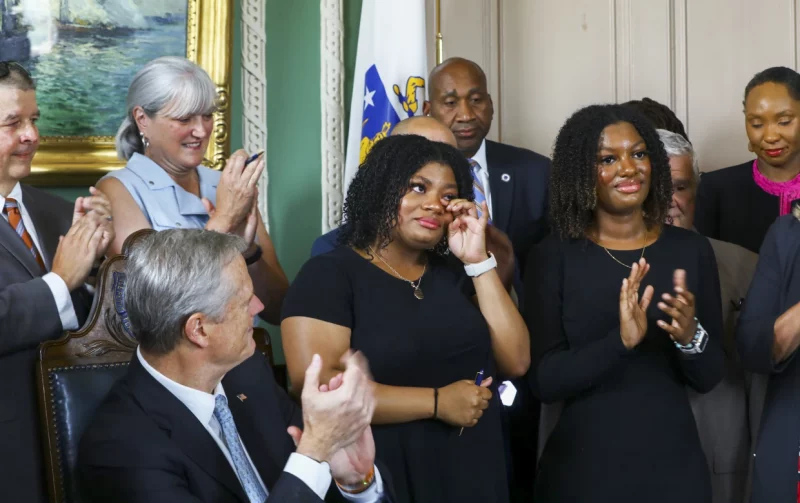
Deanna Cook wipes away tears Tuesday after Massachusetts Gov. Charlie Baker signed the CROWN Act at the State House in Boston. (Pat Greenhouse / Boston Globe via Getty Images)

Massachusetts has joined the growing list of states that have banned discrimination based on natural hairstyles. 

Gov. Charlie Baker, a Republican, on Tuesday signed the state’s version of the CROWN Act, which stands for “Create a Respectful and Open World for Natural Hair.” 

Variations of the legislation have cropped up around the country in recent years. The new Massachusetts law, which was passed unanimously by both chambers of the Legislature, specifically guards against discrimination “based on hair texture, hair type and hairstyles.” The law includes, but is not limited to, “natural and protective hairstyles such as braids, locks, twists, Bantu knots and other formations.”

Next to Baker at the signing ceremony were Deanna and Mya Cook, Black twins who were at the forefront of pushing for the legislation. 

In 2017, the sisters were given detention and threatened with suspension for wearing braids at Mystic Valley Regional Charter School, which the school’s dress code policy at the time prohibited. 

Read about the latest efforts to fight Black hair discrimination.

Earlier this year, the U.S. House of Representatives passed the CROWN Act to ban discrimination against natural hair.

Check out other Black culture and society news.







