Obama Breaks Down ‘Black Lives Matter’ During Panel on Criminal-Justice Reform
Share
Explore Our Galleries









Breaking News!
Today's news and culture by Black and other reporters in the Black and mainstream media.
Ways to Support ABHM?
While calling for strong, effective and fair law enforcement, the president spoke extensively on the intersection between race and the criminal-justice system.
By Breanna Edwards, The Root
To President Barack Obama, the Black Lives Matter creed-turned-movement makes sense. Speaking on a panel on criminal justice, the president attempted to explain the difference between and relevancy of the BLM mantra versus the counter chants of “All lives matter.”
“I think everybody understands all lives matter,” the president said. “I think the reason that the organizers used the phrase ‘Black lives matter’ was not because they said they were suggesting nobody else’s lives matter; rather, what they were suggesting was, there is a specific problem that is happening in the African-American community that’s not happening in other communities. And that is a legitimate issue that we’ve got to address…”
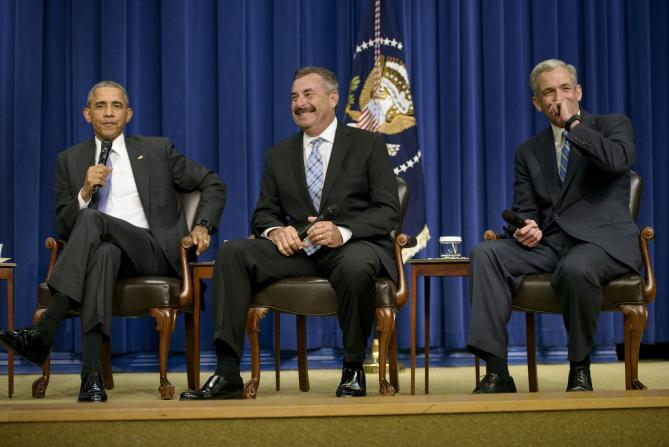
President Barack Obama speaking at an event about criminal-justice reform on the White House campus. (Photo credit: Brendan Smialowski)
“One of the ways of avoiding the politics of this and losing the moment is everybody just stepping back for a second and understanding that the African-American community is not just making this up, and it’s not just something being politicized; it’s real and there’s a history behind it. And we have to take it seriously,” he insisted.
Still, the president made sure to give a nod to the tough job police officers face and the difficult decisions they often have to make, saying that it was imperative not to “paint with a broad brush, [and to] understand that the overwhelming majority of law enforcement is doing the right thing and wants to do the right thing…”
During the panel, Obama acknowledged that the goals for criminal-justice reform in the United States would have to include fairness—regardless of race, wealth and other identities; proportionality of punishment to crime; and the recognition that incarceration is not the only solution to reducing crime and violence in communities.
“If [incarceration is] the only tool…then we’re missing opportunities for us to create safer communities through drug diversion and treatment, for example, or through more effective re-entry programs, or getting to high school kids or middle school or elementary school kids earlier so that they don’t get in trouble in the first place, and how are we resourcing that,” the president said…
“I think it’s smart for us to start the debate around nonviolent drug offenders. You are right that that’s not going to suddenly halve our incarceration rate, but … if we do that right, and we are reinvesting in treatment, and we are reinvesting resources in police departments having more guys and gals on the street who are engaging in community policing, and that’s improving community relations, then that becomes the foundation upon which the public has confidence in potentially taking a future step and looking at sentencing changes down the road,” he added.
Read the full article here.
Read more Breaking News here.
Comments Are Welcome
Note: We moderate submissions in order to create a space for meaningful dialogue, a space where museum visitors – adults and youth –– can exchange informed, thoughtful, and relevant comments that add value to our exhibits.
Racial slurs, personal attacks, obscenity, profanity, and SHOUTING do not meet the above standard. Such comments are posted in the exhibit Hateful Speech. Commercial promotions, impersonations, and incoherent comments likewise fail to meet our goals, so will not be posted. Submissions longer than 120 words will be shortened.
See our full Comments Policy here.