One Man’s Epic Quest to Visit Every Former Slave Dwelling in the United States
Share
Explore Our Galleries









Breaking News!
Today's news and culture by Black and other reporters in the Black and mainstream media.
Ways to Support ABHM?
By Tony Horwitz, Smithsonian Magazine
Joseph McGill, a descendant of slaves, has devoted his life to ensuring the preservation of these historic sites.
“Now that I have the attention of the public by sleeping in extant slave dwellings, it is time to wake up and deliver the message that the people who lived in these structures were not a footnote in American history.”
– Joseph McGill, Founder of the Slave Dwelling Project
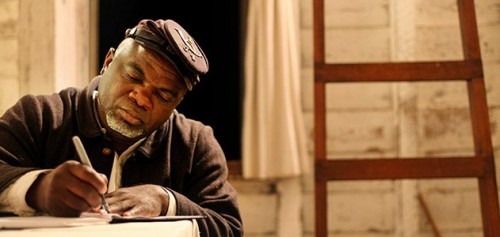
At a bygone plantation in coastal Georgia, Joseph McGill Jr. creaks open a door to inspect his quarters for the night. He enters a cramped cell with an ancient fireplace and bare walls mortared with oyster shell. There is no furniture, electricity or plumbing.
“I was expecting a dirt floor, so this is nice,” McGill says, lying down to sample the hard pine planks. “Might get a decent sleep tonight.”
Some travelers dream of five-star hotels, others of visiting seven continents. McGill’s mission: to sleep in every former slave dwelling still standing in the United States. Tonight’s stay, in a cabin on Georgia’s Ossabaw Island, will be his 41st such lodging.
McGill is 52, with a desk job and family, and isn’t fond of sleeping rough. A descendant of slaves, he also recognizes that re-inhabiting places of bondage “seems strange and upsetting to some people.” But he embraces the discomfort, both physical and psychological, because he wants to save slave dwellings and the history they hold before it’s too late.
“Americans tend to focus on the ‘big house,’ the mansion and gardens, and neglect the buildings out back,” he says. “If we lose slave dwellings, it’s that much easier to forget the slaves themselves.”
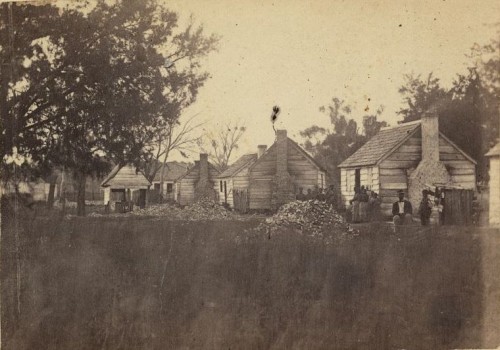
A century ago, the whitewashed cabins of former slaves remained as ubiquitous a feature of the Southern landscape as Baptist churches or Confederate monuments. Many of these dwellings were still inhabited by the families of the four million African-Americans who had gained freedom in the Civil War. But as blacks migrated en masse from the South in the 20th century, former slave quarters—most of which were cheaply built from wood—quickly decayed or were torn down. Others were repurposed as toolsheds, garages or guest cottages. Of those that remain, many are now endangered by neglect, and by suburban and resort development in areas like the Georgia and Carolina Low Country, a lush region that once had the densest concentration of plantations and enslaved people in the South.
[…]
“I’m not trying to provoke people to anger,” he says. His missions are preservation and education, and he needs the cooperation of the owners and stewards of former slave dwellings who might be put off by a more strident approach. He also feels blacks and whites need to talk openly about this history, rather than retreat into age-old division and distrust. “I want people to respect and restore these places, together, and not be afraid to tell their stories.”
This has happened in gratifying ways during a number of his stays. He tells of two sisters who had avoided any contact with the Virginia plantation where their ancestors were enslaved, despite invitations to visit. After overnighting with him at a slave cabin on the site, and realizing there was genuine interest in their family’s history, one of the women became a volunteer guide at the plantation. Local students, black and white, have joined McGill and written essays about how the experience changed their views of race and slavery. “Suddenly, what I read in textbooks became something I was able to see in my mind’s eye,” wrote one teenager in South Carolina.
To continue reading the full article, click here.
For more Breaking News, click here.
Comments Are Welcome
Note: We moderate submissions in order to create a space for meaningful dialogue, a space where museum visitors – adults and youth –– can exchange informed, thoughtful, and relevant comments that add value to our exhibits.
Racial slurs, personal attacks, obscenity, profanity, and SHOUTING do not meet the above standard. Such comments are posted in the exhibit Hateful Speech. Commercial promotions, impersonations, and incoherent comments likewise fail to meet our goals, so will not be posted. Submissions longer than 120 words will be shortened.
See our full Comments Policy here.