Poll Finds Most in U.S. Hold Dim View of Race Relations
Share
Explore Our Galleries









Breaking News!
Today's news and culture by Black and other reporters in the Black and mainstream media.
Ways to Support ABHM?

A New York Times/CBS News poll conducted last week reveals that nearly six in 10 Americans, including heavy majorities of both whites and blacks, think race relations are generally bad, and that nearly four in 10 think the situation is getting worse. By comparison, two-thirds of Americans surveyed shortly after President Obama took office said they believed that race relations were generally good.
The swings in attitude have been particularly striking among African-Americans. During Mr. Obama’s 2008 campaign, nearly 60 percent of blacks said race relations were generally bad, but that number was cut in half shortly after he won. It has now soared to 68 percent, the highest level of discontent among blacks during the Obama years and close to the numbers recorded in the aftermath of the riots that followed the 1992 acquittal of Los Angeles police officers charged in the beating of Rodney King.
Only a fifth of those surveyed said they thought race relations were improving, while about 40 percent of both blacks and whites said they were staying essentially the same.
Respondents tended to have much sunnier views of race relations in their own communities.
For instance, while only 37 percent said they thought race relations were generally good in the United States, more than twice that share, 77 percent, thought they were good in their communities, a number that has changed little over the past 20 years. Similarly, only a third thought that most people were comfortable discussing race with someone of another race, but nearly three-quarters said they were comfortable doing so themselves.
[…]
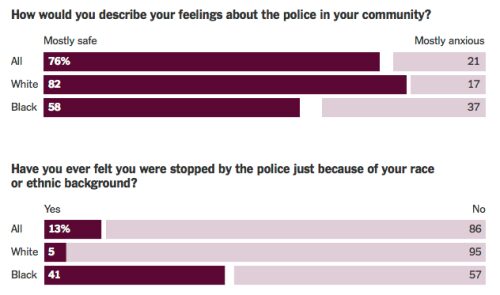
Deep racial schisms were also evident in responses about law enforcement and the criminal justice system. About three-fourths of blacks said they thought that the system was biased against African-Americans, and that the police were more likely to use deadly force against a black person than a white person. Only 44 percent of whites felt that the system was biased against blacks.
Clearly, views of the police are informed by personal experience. Four in 10 blacks, and nearly two-thirds of black men, said they felt they had been stopped by the police just because of their race or ethnicity, compared with only one in 20 whites. Fully 72 percent of blacks said they had suffered what they perceived as racial discrimination, compared with 31 percent of whites.
At a time when the unemployment rate for blacks is double that for whites and black households earn 40 percent less, blacks continue to assert they do not enjoy an equal shot at attaining financial success. The share of blacks who said whites have a better chance to get ahead rose by 14 percentage points in about a year’s time, to 60 percent. More than half of whites said blacks have equal opportunities, compared with about a third of blacks who said so.
But in a finding that may highlight class divisions more than racial ones, identical majorities of blacks and whites, 59 percent, said the economy enabled only a few people at the top to get ahead….
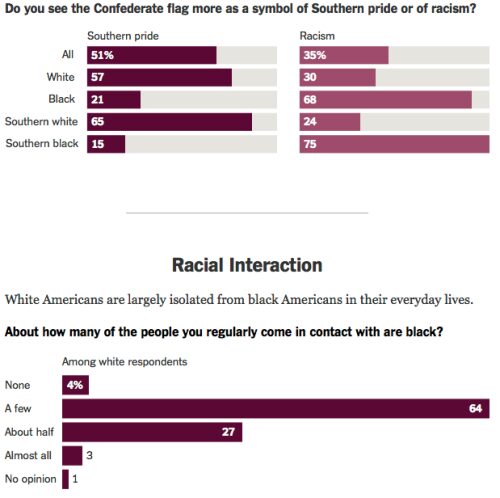
In large measure, the poll found that blacks and whites live in separate societies. Most whites say they do not live (79 percent), work (81 percent), or come in regular contact (68 percent) with more than a few blacks. While the numbers have not changed among whites in the past 15 years, the poll suggested some erosion in residential segregation among blacks. Only a third of blacks surveyed said that almost all of the people who lived near their homes were of the same race, compared with half who said so in a 2000 Times poll.
Read full article here.
More Breaking News here.
Comments Are Welcome
Note: We moderate submissions in order to create a space for meaningful dialogue, a space where museum visitors – adults and youth –– can exchange informed, thoughtful, and relevant comments that add value to our exhibits.
Racial slurs, personal attacks, obscenity, profanity, and SHOUTING do not meet the above standard. Such comments are posted in the exhibit Hateful Speech. Commercial promotions, impersonations, and incoherent comments likewise fail to meet our goals, so will not be posted. Submissions longer than 120 words will be shortened.
See our full Comments Policy here.