Special News Series: Rising Up For Justice! – Houston Bids Goodbye to George Floyd
Share
Explore Our Galleries









Breaking News!
Today's news and culture by Black and other reporters in the Black and mainstream media.
Ways to Support ABHM?
Introduction To This Series:
This post is one installment in an ongoing news series: a “living history” of the current national and international uprising for justice.
Today’s movement descends directly from the many earlier civil rights struggles against repeated injustices and race-based violence, including the killing of unarmed Black people. The posts in this series serve as a timeline of the uprising that began on May 26, 2020, the day after a Minneapolis police officer killed an unarmed Black man, George Floyd, by kneeling on his neck. The viral video of Floyd’s torturous suffocation brought unprecedented national awareness to the ongoing demand to truly make Black Lives Matter in this country.
The posts in this series focus on stories of the particular killings that have spurred the current uprising and on the protests taking place around the USA and across the globe. Sadly, thousands of people have lost their lives to systemic racial, gender, sexuality, judicial, and economic injustice. The few whose names are listed here represent the countless others lost before and since. Likewise, we can report but a few of the countless demonstrations for justice now taking place in our major cities, small towns, and suburbs.
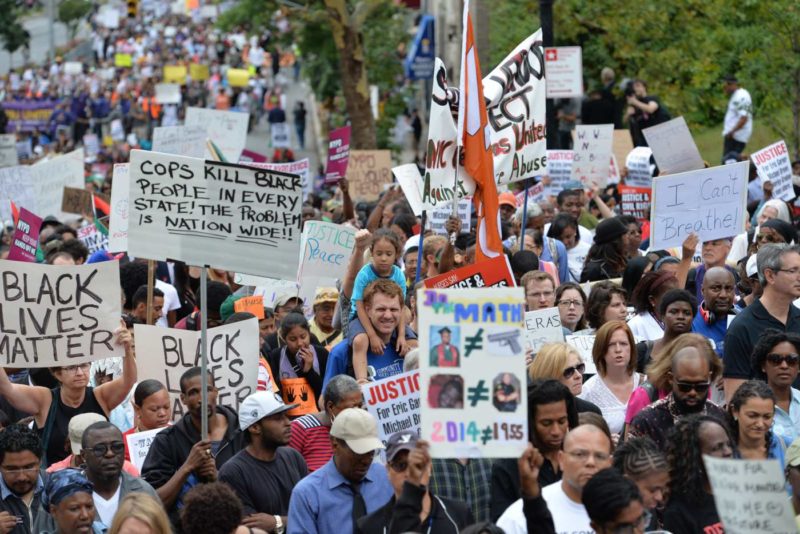
To view the entire series of Rising Up for Justice! posts, insert “rising up” in the search bar above.
Houston Bids Goodbye to George Floyd, Whose Killing Galvanized a Movement
The funeral served as both a national reckoning and a moment of personal mourning. The Rev. Al Sharpton demanded more action against police brutality.
By Manny Fernandez and Patricia Mazzei, NY Times
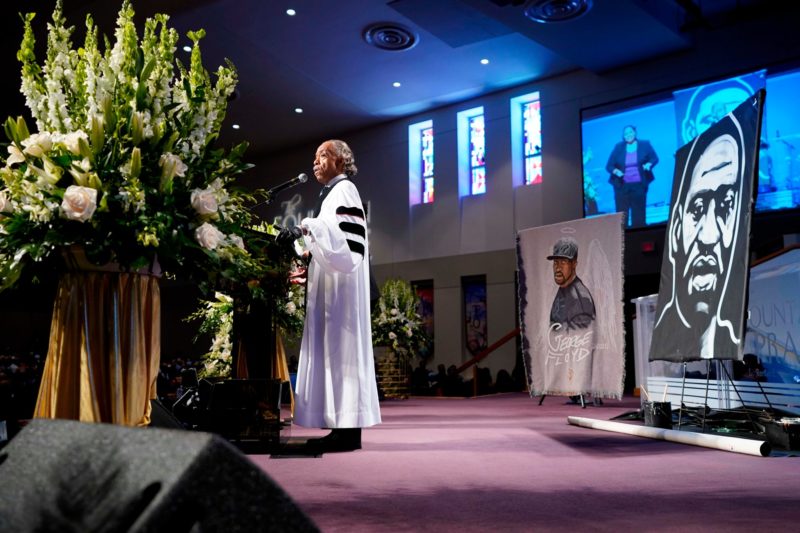
David J. Phillip/Agence France-Presse — Getty Images
June 9, 2020
HOUSTON — George Floyd died at the hands of police officers in Minneapolis. A thousand miles to the south, in the Texas city where he was raised, two rows of police officers saluted as his coffin went past.
Hours before Mr. Floyd’s funeral began at a southwest Houston church, uniformed officers stood between the hearse and the front doors. As relatives and friends pushed the gold coffin with blue trimming into the church, the officers raised their hands in a show of respect.
Mr. Floyd’s funeral and the public viewing that preceded it a day earlier have been a counterpoint to the fury that his death touched off in cities across America. Mr. Floyd, who grew up in a tough public housing complex in Houston’s predominantly black Third Ward, was considered a native son, and the tone adopted by protesters, activists, elected officials and police officers has been one of honoring a grieving Houston family.
Inside the Fountain of Praise church, Mr. Floyd, 46, the emblem of an international movement whose name has been chanted by thousands of people since his death, was remembered as the son, brother, uncle and father that he was in life.
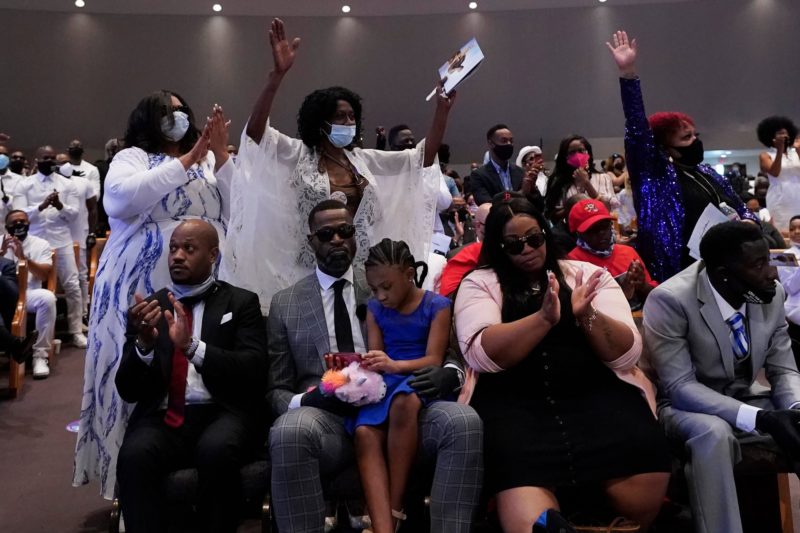
The family of George Floyd, including his daughter Gianna Floyd, center in blue, at the funeral service. Pool photo by David J. Phillip
George Perry Floyd Jr. was born in North Carolina but grew up in the Cuney Homes housing complex in Houston. He was a 1993 graduate of Jack Yates High School, where he played on the basketball team as a 6-foot-6 power forward “able to dunk with both hands.” And he was a father of five and grandfather of two, according to the funeral program.
His relatives referred to him as “Superman.”
“The world knows George Floyd,” said Kathleen McGee, one of his aunts, surrounded by relatives, all dressed in white. “I know him as Perry Jr. He was a pesky little rascal, but we all loved him.”
Read the full article here.
Comments Are Welcome
Note: We moderate submissions in order to create a space for meaningful dialogue, a space where museum visitors – adults and youth –– can exchange informed, thoughtful, and relevant comments that add value to our exhibits.
Racial slurs, personal attacks, obscenity, profanity, and SHOUTING do not meet the above standard. Such comments are posted in the exhibit Hateful Speech. Commercial promotions, impersonations, and incoherent comments likewise fail to meet our goals, so will not be posted. Submissions longer than 120 words will be shortened.
See our full Comments Policy here.