Special News Series: Rising Up For Justice! – Peaceful Portland protests after federal withdrawal
Share
Explore Our Galleries









Breaking News!
Today's news and culture by Black and other reporters in the Black and mainstream media.
Ways to Support ABHM?
Introduction To This Series:
This post is one installment in an ongoing news series: a “living history” of the current national and international uprising for justice.
Today’s movement descends directly from the many earlier civil rights struggles against repeated injustices and race-based violence, including the killing of unarmed Black people. The posts in this series serve as a timeline of the uprising that began on May 26, 2020, the day after a Minneapolis police officer killed an unarmed Black man, George Floyd, by kneeling on his neck. The viral video of Floyd’s torturous suffocation brought unprecedented national awareness to the ongoing demand to truly make Black Lives Matter in this country.
The posts in this series focus on stories of the particular killings that have spurred the current uprising and on the protests taking place around the USA and across the globe. Sadly, thousands of people have lost their lives to systemic racial, gender, sexuality, judicial, and economic injustice. The few whose names are listed here represent the countless others lost before and since. Likewise, we can report but a few of the countless demonstrations for justice now taking place in our major cities, small towns, and suburbs.
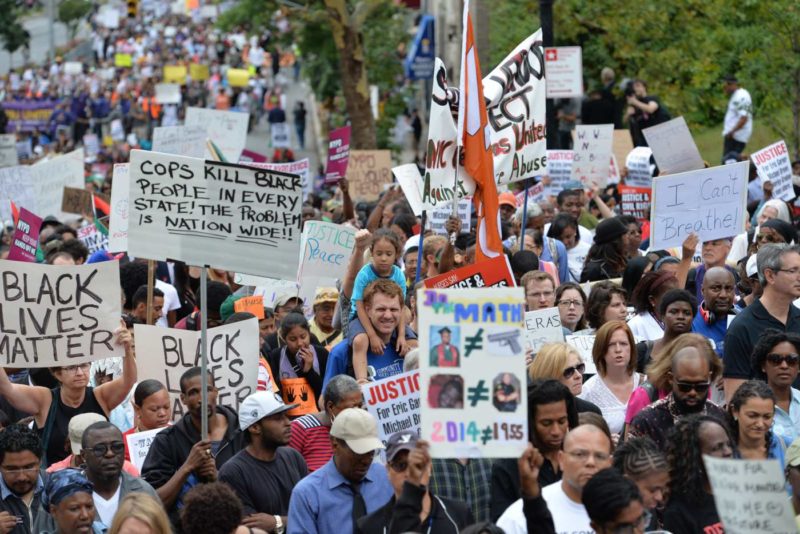
To view the entire series of Rising Up for Justice! posts, insert “rising up” in the search bar above.
Portland sees peaceful night of protests following withdrawal of federal agents
By Chris McGreal in Portland, theGuardian.com
July 31, 2020
Thursday night’s protest passed off without major incident or intervention by the police in the absence of federal officers
The withdrawal of federal agents from frontline policing of demonstrations in downtown Portland significantly reduced tensions in the city overnight.
Protesters in support of Black Lives Matter once again rallied near the federal courthouse that became a flashpoint, and the scene of nightly battles amid the swirl of teargas, after Donald Trump dispatched agents to end what he called anarchy in the city after weeks of demonstrations.
But in the absence of the federal officers, Thursday night’s protest passed off without major incident or intervention by the police.
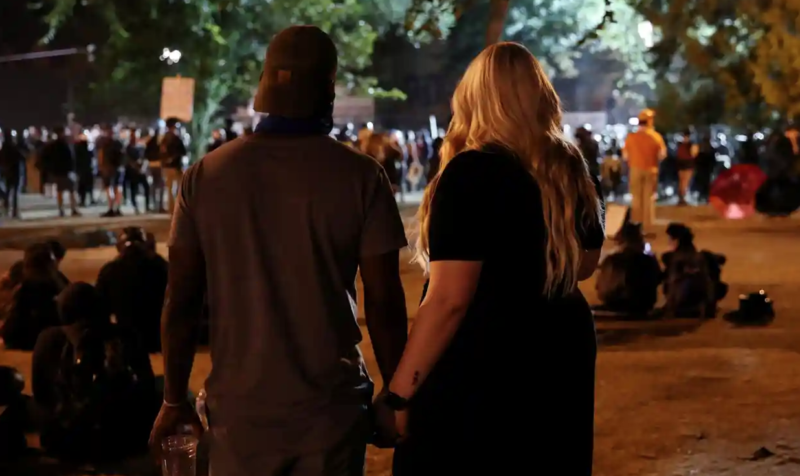
People attend a protest against racial inequality and police violence in Portland, Oregon, on Thursday. Photograph: Caitlin Ochs/Reuters
On Wednesday, Oregon’s governor, Kate Brown, agreed with the White House that the state police would take over responsibility for guarding the courthouse after weeks of escalating protests. She said that “Trump’s troops” were behaving like an occupying army in Portland and provoking unrest with heavy-handed tactics.
In contrast, the state troopers did not intervene even when the scale of the protest on Thursday night passed the point, as demonstrators shook the fence around the courthouse, at which in early demonstrations the federal agents generally fired teargas, stun grenades and baton rounds.
Read the full article and view videos here.
Comments Are Welcome
Note: We moderate submissions in order to create a space for meaningful dialogue, a space where museum visitors – adults and youth –– can exchange informed, thoughtful, and relevant comments that add value to our exhibits.
Racial slurs, personal attacks, obscenity, profanity, and SHOUTING do not meet the above standard. Such comments are posted in the exhibit Hateful Speech. Commercial promotions, impersonations, and incoherent comments likewise fail to meet our goals, so will not be posted. Submissions longer than 120 words will be shortened.
See our full Comments Policy here.