Trailblazing America’s Black Holocaust Museum poised to reopen
Share
Explore Our Galleries









Breaking News!
Today's news and culture by Black and other reporters in the Black and mainstream media.
Ways to Support ABHM?
By Mary Louise Schumacher, Milwaukee Journal Sentinel
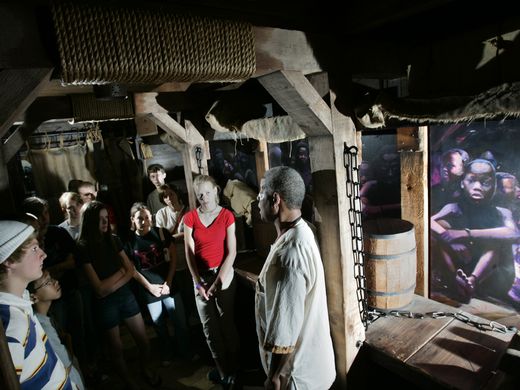
Griot Tony Courtney describes the brutal realities of the capture and transport of millions of Africans to the New World. The tour group stands inside the replica of a slave ship’s cargo hold in the former ABHM galleries in 2005. Milwaukee Journal Sentinel
Near the end of his presidency, Barack Obama stood in front of one of the most spectacular museums ever erected on the National Mall and spoke about embracing hard truths. “Yes, a clear-eyed view of history can make us uncomfortable,” he said at the opening of the Smithsonian National Museum of African American History and Culture. “It’ll shake us out of familiar narratives.”
In recent weeks, in Montgomery, Ala., overlooking the birthplace of the civil rights movement, a solemn memorial was unveiled that documents the lynching deaths of more than 4,400 African-Americans.
Related: Alabama memorial captures the scale of racial terror in the U.S.
There is a level of truth telling at the heart of these celebrated projects, both of which have attracted international headlines and massive crowds, that was preceded by a far less known museum in Milwaukee 30 years ago.
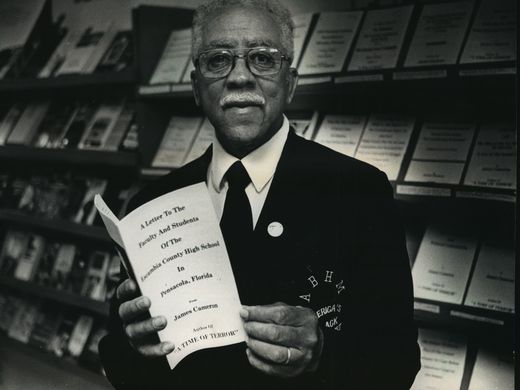
Dr. James Cameron with some of the many booklets of short essays on US history and race relations he authored, at the 1988 opening of ABHM. Milwaukee Journal Sentinel
Without funding from Google or presidential accolades, America’s Black Holocaust Museum was founded by James Cameron, a survivor of one of the nation’s most notorious lynchings.
Cameron’s museum was unique in the nation for its emphasis on hard truths. Decades before #BlackLivesMatter, for instance, Cameron drew a direct line from the history of lynchings to the shooting deaths of young black men by police officers.
Cameron “was a pioneer in articulating the legacy of America’s racial violence,” said Bryan Stevenson, executive director of the Equal Justice Initiative, the nonprofit legal advocacy group that opened the National Memorial for Peace and Justice in Alabama. “I consider him a huge influence and someone who inspired me enormously,” he added.
This fall, Cameron’s prescient and potent museum, which shuttered a few years after its founder’s death in 2006, is slated to reopen in Milwaukee. It is part of the $17.7 million Historic Garfield Redevelopment project, led by Maures Development LLC and Jeffers & Co., which also includes apartments and commercial space.
A free public event Monday featuring actor and activist Danny Glover is part of a two-day celebration of the project and the museum. Glover is part of Sankofa, a social justice group founded in 2013 by Harry Belafonte that brings attention to worthy grassroots projects through the involvement of high-profile artists.
Related: When America’s Black Holocaust Museum first opened — in 1988
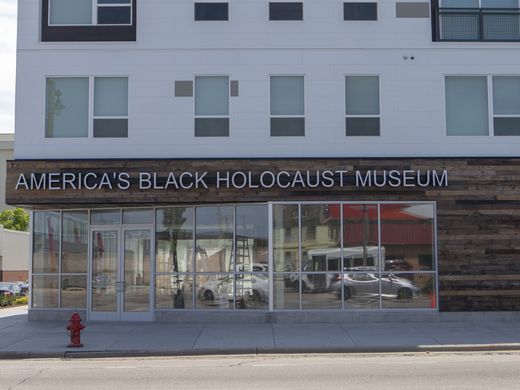
The new ABHM galleries, currently under construction, are scheduled to open in Fall 2018. Milwaukee Journal Sentinel
“Most of the time, when a museum closes, it doesn’t reopen,” said Ald. Milele Coggs, who said discussions about the future of the museum have been active for years at City Hall. Her first phone calls and meetings as an elected official were about it, she said.
The rebirth of America’s Black Holocaust Museum prompts questions. What will it be without Cameron, whose presence and stories were so essential to it? Why did it take a decade of struggle to get it reopened? Are we more prepared to confront Cameron’s ideas today, in a time of national reckoning around issues of race?
To consider the museum’s future we need to understand the terrible story that defined Cameron’s life….
Read the full article and watch the video here.
Read more Breaking News here.
Comments Are Welcome
Note: We moderate submissions in order to create a space for meaningful dialogue, a space where museum visitors – adults and youth –– can exchange informed, thoughtful, and relevant comments that add value to our exhibits.
Racial slurs, personal attacks, obscenity, profanity, and SHOUTING do not meet the above standard. Such comments are posted in the exhibit Hateful Speech. Commercial promotions, impersonations, and incoherent comments likewise fail to meet our goals, so will not be posted. Submissions longer than 120 words will be shortened.
See our full Comments Policy here.