What Happened When a Brooklyn Neighborhood Policed Itself for Five Days
Share
Explore Our Galleries









Breaking News!
Today's news and culture by Black and other reporters in the Black and mainstream media.
Ways to Support ABHM?
Maria Cramer, The New York Times
On a two-block stretch of Brownsville in April, the police stepped aside and let residents respond to 911 calls. It was a bold experiment that some believe could redefine law-enforcement in New York City.
[…]
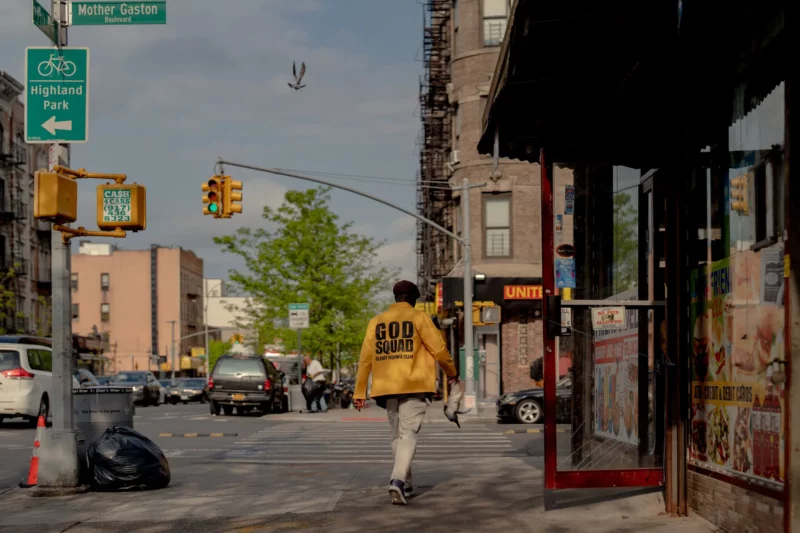
Several times a year, workers from Brownsville In Violence Out stand sentry on two blocks for five days. The police channel all 911 calls from that area to the civilians. Unless there is a major incident or a victim demands an arrest, officers, always in plainclothes, shadow the workers.
The civilians have no arrest powers. But they have persuaded people to turn in illegal guns, prevented shoplifting, kept a man from robbing a bodega and stopped a pregnant woman from hitting a boyfriend who had not bought a car seat and a stroller as he had promised.
They are part of the Brownsville Safety Alliance, a group of neighborhood and city groups, police officers and members of the Kings County District Attorney’s office that is trying to ensure that fewer people are arrested and entangled in the criminal justice system.
As the men and women from Brownsville In Violence Out watch for trouble, agencies offering services like free child care and addiction recovery sit at folding tables, distributing pamphlets and luring passers-by with games, stress balls and pens.
Over the next three years, the city will provide $2.1 million to help link the local organizations that participate most frequently in the Safety Alliance so that they can work cohesively throughout the year.
The effort mirrors others that have sprung up after demonstrations swept New York and much of the country to protest the police killing of George Floyd in Minneapolis. They are meant to modulate the use of officially sanctioned force, using a neighborhood’s innate desire for order as a tool.
Read more about Brownsville’s attempt to eradicate police brutality in the original article.
Learn about other efforts to put power back into Black hands in this virtual exhibit.
Find more Breaking News here.
Comments Are Welcome
Note: We moderate submissions in order to create a space for meaningful dialogue, a space where museum visitors – adults and youth –– can exchange informed, thoughtful, and relevant comments that add value to our exhibits.
Racial slurs, personal attacks, obscenity, profanity, and SHOUTING do not meet the above standard. Such comments are posted in the exhibit Hateful Speech. Commercial promotions, impersonations, and incoherent comments likewise fail to meet our goals, so will not be posted. Submissions longer than 120 words will be shortened.
See our full Comments Policy here.